Types of Polycarboxylate Superplasticizer
Polycarboxylate superplasticizer, often called PCE, polycarboxylate ether, or PCE water reducer, is the most widely used class of high-range water reducing admixture in modern concrete. This page is the central ADMIXTEC reference for polycarboxylate superplasticizer. It covers what the material is, how it performs, where it is used, how to select and dose it, and what buyers should check in a specification before placing an order.
What is Polycarboxylate Superplasticizer?
A polycarboxylate superplasticizer is a synthetic polymer admixture added to concrete and mortar to disperse cement particles. It allows a large reduction in mixing water while keeping or improving workability. The terms polycarboxylate ether, polycarboxylic superplasticizer, PCE superplasticizer, and PCE water reducer all describe the same product family. In standards language, PCE products usually fall within the high-range water reducer category, sometimes with set-retarding characteristics depending on formulation.
Compared with earlier generations of plasticizers, such as lignosulfonates and sulfonated naphthalene formaldehyde (SNF), PCE delivers higher water reduction at lower dosage. It also gives formulators far more control over slump retention, setting behavior, and early strength development. This flexibility is why PCE has become the standard choice for ready-mix concrete, precast elements, and high-performance concrete.
How PCE works in fresh concrete
When cement contacts water, its particles tend to flocculate and trap water inside small clusters. A polycarboxylate superplasticizer adsorbs onto the surfaces of cement grains through its charged backbone. Its long side chains extend outward into the pore solution and keep neighboring particles apart through steric hindrance, supported by a smaller electrostatic repulsion effect. The trapped water is released, so the mix flows freely even at a low water-cement ratio. Because steric hindrance is less sensitive to ion concentration than pure electrostatic repulsion, the dispersing effect of PCE lasts longer than that of older admixture types.
Available forms
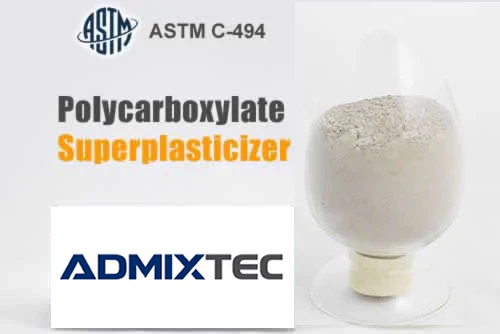
ADMIXTEC supplies polycarboxylate superplasticizer as liquid and as powder. Liquid products are commonly offered as concentrated mother liquor, which concrete admixture producers dilute and blend with other components, and as ready-to-use formulated products for direct dosing at the batching plant. Powder PCE is used mainly in dry-mix mortars, grouts, and self-leveling compounds, where a liquid admixture cannot be added during production.
Key Performance & Differentiators
The main value of a polycarboxylate superplasticizer lies in its high water reduction. Depending on the cement, the mix design, and the dosage, PCE commonly achieves water reduction well above what SNF or lignosulfonate products deliver. Lower water content directly reduces the water-cement ratio, which raises compressive strength at both early and later ages. It also reduces capillary porosity, which improves impermeability, freeze-thaw resistance, and long-term durability.
Workability and slump retention
PCE gives concrete high flowability with good cohesion, which supports pumping over long distances and to tall structures. Slump retention can be tuned by selecting or blending different PCE types. Water-reducing grades produce strong initial dispersion, while slump-retaining grades release their dispersing effect gradually during transport and placement. This allows ready-mix producers to hold workability through long hauls and hot weather without adding water on site.
Low dosage and low impurity levels
Because PCE is efficient, typical dosages are low relative to older admixtures. Well-produced polycarboxylate superplasticizer generally has low chloride and low alkali content, which reduces the risk of reinforcement corrosion and limits the contribution to alkali-aggregate reaction. Actual values vary by product, and buyers should confirm them on the technical data sheet and certificate of analysis for each batch.
Formulation flexibility
One clear differentiator of PCE is that its molecular structure can be adjusted to target specific outcomes. Producers can choose grades oriented toward high water reduction, extended slump retention, early strength for precast, or reduced viscosity for high-strength mixes. This makes polycarboxylate superplasticizer a platform rather than a single product, and it allows admixture blenders to build formulations suited to local materials.
Recommended Applications
Ready-mix concrete is the largest application for polycarboxylate superplasticizer. Here the priority is usually a balance of water reduction and slump retention, so that concrete arrives at the site with the required workability. Blends of water-reducing and slump-retaining PCE grades are common in this sector.
Precast and prestressed concrete plants use PCE to achieve high early strength, which shortens demolding cycles and improves mold turnover. In these plants, early-strength PCE grades are often combined with steam curing or accelerated curing regimes, and slump retention is less critical because placement happens quickly.
Self-compacting concrete relies heavily on polycarboxylate superplasticizer. SCC must flow under its own weight, fill congested reinforcement, and resist segregation. PCE provides the required flowability, while a viscosity modifying admixture or adequate fines content maintains stability.
High-strength and high-performance concrete, used in high-rise columns, bridges, and marine structures, depends on very low water-cement ratios. PCE makes these mixes workable. Viscosity-reducing grades help when high binder content makes the mix sticky and difficult to pump.
Powder PCE serves dry-mix mortar, tile adhesives, cementitious grouts, and self-leveling floor screeds. In these products the superplasticizer must disperse quickly once water is added and work well with other dry additives such as cellulose ethers and redispersible polymer powders.
Typical Selection & Dosage Considerations
Selecting a polycarboxylate superplasticizer starts with the performance goal. A ready-mix producer with long transport times needs a different PCE balance than a precast plant that values early strength. Defining required water reduction, slump retention time, setting behavior, and strength targets makes the choice far more precise.
Dosage range
PCE dosage is usually expressed as a percentage of total cementitious material by weight. For formulated liquid products, dosage is commonly in the range of a few tenths of a percent up to around two percent, depending on solid content and mix design. For mother liquor, dosage is better calculated on a solid content basis. The optimal dosage should always be established through trial mixes using the actual cement, supplementary materials, and aggregates of the project. Overdosing can cause bleeding, segregation, and excessive set retardation.
Air content and defoaming
Polycarboxylate superplasticizer can entrain some air, and the air voids may be large and unstable. Formulators therefore often add a defoamer to control air content, and then introduce a dedicated air-entraining agent where freeze-thaw resistance requires a stable air void system. Air content should be checked during trial mixes and regularly in production.
Combining with other admixtures
PCE is generally not compatible with SNF or melamine-based superplasticizers in the same mix or the same storage tank. Mixing them can cause rapid loss of workability or precipitation. When switching an existing plant from SNF to PCE, tanks, pipes, and dosing equipment should be cleaned thoroughly. Retarders, accelerators, and viscosity modifiers can be combined with PCE, but each combination should be verified by testing.
Cement, SCM & Aggregate Compatibility
The performance of any polycarboxylate superplasticizer depends on the materials it meets in the mix. Cement chemistry plays a major role. Cements with high tricalcium aluminate content, high alkali content, or unusual sulfate balance can adsorb PCE quickly, which raises the required dosage or shortens slump retention. Cement fineness also matters, since finer cement offers more surface area for adsorption.
Supplementary cementitious materials
Fly ash, ground granulated blast furnace slag, silica fume, and limestone powder are widely used with PCE. Slag and good-quality fly ash usually work well and can improve workability. Silica fume has a very high surface area and generally increases superplasticizer demand. Fly ash with high carbon content can adsorb admixtures and affect air content, so it should be tested before use.
Clay in aggregates
Clay contamination in sand is one of the most common causes of poor PCE performance. Swelling clays such as montmorillonite can absorb the side chains of polycarboxylate molecules, which removes them from the dispersing role. The result is high dosage demand, fast slump loss, and inconsistent quality. Where clay content in local aggregates is high, washing the sand, controlling the methylene blue value, or using clay-tolerant PCE grades can help. ADMIXTEC recommends that buyers share their aggregate characteristics during product selection so that the formulation can be matched to the materials.
QC & Specification Fields
A clear specification protects both buyer and supplier. For polycarboxylate superplasticizer, the product specification usually covers homogeneity indicators measured on the admixture itself and performance indicators measured in test concrete or mortar.
Homogeneity indicators include appearance, solid content, density, and pH. Solid content is especially important because it determines effective dosage and price per unit of active material. Chloride content and total alkali content, often reported as sodium oxide equivalent, are also standard fields. For powder products, fineness and moisture content are typically included.
Performance indicators are measured by comparing test concrete with a reference mix. Common fields are water reduction ratio, bleeding ratio, air content, setting time difference, slump or slump flow retention over time, compressive strength ratio at defined ages, and drying shrinkage ratio. Buyers often reference national or international test methods for these fields. Common reference frameworks include ASTM C494, EN 934-2, and GB 8076. The applicable method and acceptance limits should be agreed in the purchase contract, and conformity should be confirmed by test reports rather than assumed.
Batch consistency is as important as headline performance. A reliable supplier tests each batch for key homogeneity indicators and issues a certificate of analysis. Buyers can keep retained samples and run periodic mortar or concrete checks to confirm that performance remains stable across deliveries.
Packaging, Storage & Shelf Life
Liquid polycarboxylate superplasticizer is commonly supplied in plastic drums, 1,000-liter IBC totes, and flexitanks for container shipment. Bulk tanker delivery is possible for local customers with suitable storage. Powder PCE is usually packed in multi-layer bags of 25 kg, with larger bulk bags available for high-volume users. Packaging options and fill weights should be confirmed when ordering.
Liquid PCE should be stored in clean plastic, fiberglass, or stainless steel tanks, out of direct sunlight, and protected from freezing and excessive heat. Because PCE solutions are water-based and slightly acidic, they can support microbial growth if contaminated, so containers should remain sealed and tanks should be cleaned periodically. If the liquid has frozen, it should be thawed fully and stirred before use, and its performance should be rechecked. Powder products should be kept dry and sealed to prevent caking.
Shelf life depends on form, formulation, and storage conditions. Powder grades usually keep longer than liquid grades. The exact shelf life for each ADMIXTEC product is stated on its technical data sheet, and material stored beyond that period should be retested before use.
Technical Documents
ADMIXTEC provides a technical data sheet for each polycarboxylate superplasticizer grade. The TDS describes the product type, typical properties, recommended dosage range, application notes, and storage guidance. A safety data sheet is available for handling, transport, and emergency information. Each shipment can be accompanied by a certificate of analysis showing batch test results for the agreed specification fields.
For project qualification, buyers can request trial test reports using their own cement and aggregate samples. Where a project requires conformity with a specific standard or third-party test, the requirement should be stated at the inquiry stage so that the correct documentation can be confirmed before supply.
FAQ
Is polycarboxylate ether the same as polycarboxylate superplasticizer?
Yes. Polycarboxylate ether, PCE, PCE water reducer, and polycarboxylate superplasticizer refer to the same family of high-range water reducing polymers. Individual grades differ in molecular design and performance focus, but they belong to the same product category.
What is the difference between PCE and SNF superplasticizer?
SNF disperses cement mainly through electrostatic repulsion, while PCE relies largely on steric hindrance. PCE generally offers higher water reduction, lower dosage, better slump retention, and more design flexibility. SNF is less sensitive to clay and is often lower in cost. The two types should not be mixed together.
Why does my concrete lose slump quickly with PCE?
Fast slump loss usually comes from clay in aggregates, high cement adsorption, high temperature, or a formulation with too little slump-retaining component. Testing the aggregates and adjusting the PCE blend typically resolves the issue.
Should I buy mother liquor or a formulated product?
Mother liquor suits admixture producers who blend their own formulations for local materials. Formulated products suit concrete producers who want a ready-to-dose admixture. The right choice depends on in-house formulation capability and testing resources.
Can PCE be used in cold or hot weather?
Yes, with suitable formulation. In hot weather, slump-retaining grades and retarders help maintain workability. In cold weather, early-strength grades and accelerators support strength gain. Trial mixes at expected site temperatures are recommended.