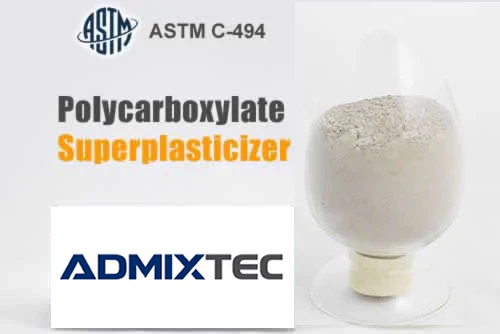
What is PCE Powder?
PCE powder is the solid, free-flowing form of a polycarboxylate ether superplasticizer. It contains the same type of comb-shaped polymer used in liquid polycarboxylate admixtures, but the water has been removed so the product can be shipped, stored and dosed as a dry material. Commercial grades usually look like a white to light yellow powder or fine granule, with a typical solid content of about 95% or higher.
The powder form exists mainly for factory-made dry-mix mortars. Products such as self-leveling underlayments, tile adhesives, cementitious grouts, repair mortars and plasters are sold as dry bags, and a liquid admixture cannot be blended into them. PCE powder can be pre-mixed with cement, sand, fillers and other additives. The polymer then dissolves and starts working only when the end user adds water on site. Ready-mix and precast concrete plants also use PCE powder when long transport distances, freezing climates or limited tank storage make liquid admixtures inconvenient.
PCE powder compared with liquid PCE
Both forms disperse cement through the same mechanism. The practical differences come from handling, logistics and the products they suit.
| Property | PCE Powder | Liquid PCE (typical 40–50% solids) |
|---|---|---|
| Physical form | Free-flowing powder or granule | Aqueous solution |
| Main applications | Dry-mix mortars, bagged products, remote concrete projects | Ready-mix concrete, precast, site-batched concrete |
| Freight efficiency | High, since little water is shipped | Lower, since more than half of the weight is water |
| Freeze risk | None in storage | Can be affected by freezing and needs protection in cold climates |
| Main storage concern | Moisture uptake and caking | Microbial growth, sedimentation and temperature extremes |
| Typical packaging | 25 kg bags lined with PE film, or jumbo bags | IBC totes, drums, bulk tankers |
One kilogram of PCE powder replaces about two to two and a half kilograms of a 40% liquid PCE, measured on active solids. Buyers comparing quotes should therefore compare prices per kilogram of active polymer rather than per kilogram of product.
How PCE Powder Works in Cement-Based Materials
When cement meets water, its particles tend to stick together into flocs. These clusters trap part of the mixing water, which then cannot help the mix flow. Without a dispersant, producers must add extra water to reach the workability they need, and that extra water lowers strength and durability. PCE powder releases the trapped water by keeping cement particles apart.
Dissolution and adsorption
In a dry-mix mortar, the PCE powder stays inactive until water is added. The polymer then dissolves within the first moments of mixing. Its main chain carries negatively charged carboxylate groups, and these groups anchor onto the positively charged sites of the cement particles and early hydration products. How fast the polymer dissolves and adsorbs affects how quickly the mortar reaches its target flow. This is one reason two powders with similar chemistry can perform differently in the same formulation.
Steric hindrance from side chains
The defining feature of a polycarboxylate ether is its long polyether side chains, which extend from the anchored main chain into the surrounding water. When two coated particles approach each other, these side chains overlap and physically push the particles apart. This effect, called steric hindrance, works together with a smaller amount of electrostatic repulsion. Older superplasticizers such as sulfonated naphthalene formaldehyde (SNF) rely mainly on electrostatic repulsion. Steric hindrance is the main reason PCEs reach higher water reduction at lower dosages, often in the range of 25% to 40% in concrete.
Flow retention over time
Fresh cement paste keeps hydrating, and new hydration products gradually bury the adsorbed polymer. Manufacturers adjust the molecular structure, including charge density, side-chain length and side-chain density, to control how quickly the polymer adsorbs. A highly charged structure adsorbs quickly and gives strong initial dispersion. A less charged structure adsorbs gradually and maintains flow for a longer time. Formulators often blend different PCE types to balance early flow, workable time and setting behavior.
Effects on air content and setting
PCE polymers have surface-active properties and can entrain air, especially in mortars mixed with high shear. For this reason, many PCE powders already contain a defoamer, or the formulator adds one separately. PCE can also delay setting slightly, depending on its structure and dosage. Mortars that must harden fast, such as rapid-setting repair mortars, may need an accelerator or a powder grade designed for early strength.
How to Choose PCE Powder for Your Application
No single PCE powder suits every formulation. Polymer structure, the materials in the mix and the application method all affect the result, so selection should rest on laboratory trials with the buyer's own cement, fillers and other additives. The factors below help narrow the choices before trials begin.
Match the grade to the end product
Different dry-mix products require different flow behavior. A self-leveling underlayment needs fast, high flow with low viscosity and no segregation. A tile adhesive needs good workability without losing the slip resistance that keeps tiles in place. A grout needs to fill joints and voids completely within its open time.
| Application | Performance priority | Typical grade direction | Indicative dosage (by weight of binder or total dry mix) |
|---|---|---|---|
| Self-leveling underlayment | Rapid flow, low viscosity, smooth surface, stability | Fast-dispersing grade with built-in defoamer | About 0.05%–0.3% of total dry mix |
| Non-shrink and precision grout | High flow, flow retention, no bleeding | Grade with high water reduction and good retention | About 0.1%–0.3% of binder |
| Tile adhesive and plaster | Workability with retained thixotropy | Moderate-dispersing grade, often at low dosage | About 0.05%–0.2% of total dry mix |
| Repair mortar | Low water-cement ratio, early strength | Early-strength or fast-dispersing grade | About 0.1%–0.3% of binder |
| Concrete (powder used in place of liquid) | Water reduction and slump retention | Water-reducing grade combined with a retention grade | About 0.1%–0.3% of cementitious material |
These ranges are general industry guidance. The correct dosage for a specific formulation must come from trials.
Check compatibility with cement and other additives
Cement fineness, alkali content, sulfate content and the type of supplementary materials all affect how a PCE adsorbs. Dry-mix formulations add more variables, including cellulose ethers, redispersible polymer powders, calcium aluminate cement, gypsum binders, retarders and accelerators. Clay in the sand is a specific concern. Some clay minerals, especially swelling clays, can absorb the polyether side chains and consume part of the dosage, which leads to unexpected flow loss. Buyers whose sand has a high clay content should ask for a clay-tolerant grade and test it with their actual aggregate.
Evaluate physical properties and consistency
For dry-mix producers, the powder's physical behavior matters as much as its chemistry. Particle size affects how evenly the powder spreads through a blend. Flowability affects automatic dosing. Moisture content affects storage stability. Bulk density affects silo and bag handling. Batch-to-batch consistency matters most of all, because a small variation in a polymer dosed at 0.1% can noticeably change the flow of the finished product.
| Parameter | Why it matters | What to request |
|---|---|---|
| Moisture content | High moisture can lead to caking and shorter shelf life | Specified maximum, with the test method |
| pH of aqueous solution | Indicates product consistency and possible interactions | Range and solution concentration used in the test |
| Bulk density | Affects dosing equipment and packaging | Typical value and acceptable range |
| Particle size or fineness | Affects blending uniformity and dissolution speed | Sieve residue or distribution data |
| Performance test | Confirms dispersing ability, not just physical properties | Paste or mortar flow result against a reference sample |
Ask for documentation and technical support
A reliable supplier should provide a technical data sheet, a safety data sheet and a certificate of analysis for each batch. Projects that must follow a specification, such as EN 934-2 in Europe or ASTM C494 in North America, should request the actual test reports for the specific product instead of relying on general statements. Buyers should also ask about shelf life, storage conditions and the supplier's ability to adjust a grade or supply samples for trials. Technical support during formulation work often saves more money than a lower price per kilogram.
Plan storage and handling
PCE powder absorbs moisture from the air. It should be stored in sealed packaging in a dry, cool place away from direct sunlight. Opened bags should be resealed promptly. Under these conditions, many suppliers state a shelf life of about 12 months, though the actual figure depends on the product and climate. Mild lumps that break apart easily usually do not affect performance, but heavily caked material should be tested before use.
FAQ
Can PCE powder be used in concrete as well as dry-mix mortar?
Yes. PCE powder can be dissolved in water before batching or added directly to the mixer, and it works in concrete the same way liquid PCE does. Producers often choose it for remote projects, export shipments or cold climates where storing liquid admixture is difficult. Dosage should be calculated on active solids and confirmed through trial batches.
Is PCE powder better than SNF or melamine-based superplasticizers?
PCE powder usually gives higher water reduction at a lower dosage and better flow retention than SNF or sulfonated melamine formaldehyde (SMF) products. It is also lighter in color, which suits white and colored mortars. SNF and SMF can still make sense in some formulations because of cost, lower sensitivity to clay or specific setting behavior. The right choice depends on performance targets and trial results.
Why does my mortar have too much air after adding PCE powder?
PCE polymers can entrain air, and high-speed mixing makes the effect stronger. If air content is too high, check whether the powder already contains a defoamer, then consider adding a compatible defoamer to the formulation. Interactions with cellulose ethers or other surface-active additives can also increase air content.
Can different PCE powders be blended together?
Formulators often blend a fast-dispersing grade with a flow-retention grade to get both strong initial flow and longer workable time. Blends should be tested before production. Mixing PCE with SNF in the same formulation is generally not recommended, because the two types can interfere with each other and cause rapid flow loss.
How should I test PCE powder before switching suppliers?
Run side-by-side trials using your own cement, fillers, sand and additives, and keep everything else in the formulation unchanged. Compare initial flow, flow after a set time, air content, setting time, bleeding or segregation, and strength at the ages that matter for your product. Testing more than one production batch gives a better picture of the supplier's consistency.
What packaging options are available for PCE powder?
The most common packaging is a 25 kg multi-layer bag with a moisture-resistant inner liner. Large dry-mix plants may prefer jumbo bags for automatic dosing systems. Packaging options, pallet configuration and labeling requirements should be agreed before the first order.