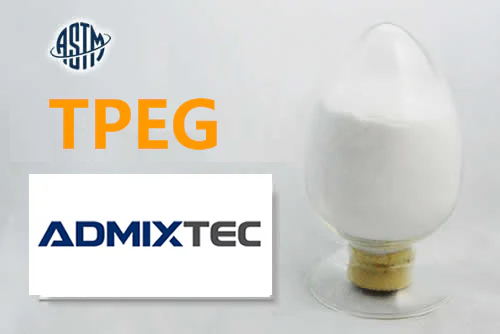
What is TPEG?
TPEG is isoprenyl polyoxyethylene ether, a polyether macromonomer used as the main raw material for polycarboxylate ether (PCE) superplasticizers. Each molecule has a polymerizable carbon–carbon double bond at one end and a long polyethylene glycol (PEG) chain at the other. The double bond comes from isoprenol (3-methyl-3-buten-1-ol). It lets TPEG join the PCE backbone during copolymerization. The PEG chain becomes the side chain that disperses cement particles in the final admixture.
In the PCE industry, TPEG belongs to the family of unsaturated alcohol ether macromonomers, alongside HPEG (methallyl polyoxyethylene ether) and newer vinyl ether types often called VPEG. These products copolymerize directly with acrylic acid. Older MPEG-based routes first require an esterification step to make methoxy polyethylene glycol methacrylate. The direct route is shorter, which is one reason TPEG became one of the most widely used macromonomers for water-reducing and slump-retaining PCE grades.
Typical physical form and grades
At room temperature, TPEG is usually supplied as a white to light yellow waxy solid, in flake or granular form. It dissolves readily in water, which suits the aqueous polymerization processes used by most PCE producers. The grade is named by its nominal molecular weight. TPEG-2400 is the most common grade for general-purpose water-reducing PCE. Grades around 3000 and 4000 are also produced for specific dispersion and slump-retention targets.
| Parameter | Typical range for TPEG-2400 (indicative) | Why it matters |
|---|---|---|
| Appearance | White to light yellow solid (flake or granule) | Strong color can indicate oxidation or heat history |
| Hydroxyl value | About 22–25 mg KOH/g | Confirms actual molecular weight against the nominal grade |
| Double bond retention | Commonly specified at 90% or higher | Determines how much macromonomer enters the polymer chain |
| pH (1% aqueous solution) | Roughly 5.0–7.0 | Affects storage stability and polymerization behavior |
| Water content | Usually 0.5% or lower | Affects dosing accuracy and solid content |
| Free PEG content | Usually a few percent at most | PEG does not polymerize and dilutes performance |
The values above are typical market ranges, not a fixed specification. Actual limits differ between producers and batches, so buyers should check each lot against its certificate of analysis.
How TPEG works in PCE superplasticizers?
TPEG has no water-reducing effect on its own. It works by becoming part of the PCE polymer. That polymer then controls how cement particles behave in fresh concrete and mortar.
Role in copolymerization
PCE producers copolymerize TPEG with acrylic acid in water, usually by free-radical polymerization with a redox initiator system and a chain transfer agent. The process typically runs at moderate temperatures. Many plants run it close to ambient temperature, which lowers energy use and simplifies equipment. The acrylic acid units form a backbone carrying carboxylate groups. The TPEG units add long PEG side chains along that backbone. The result is a comb-shaped polymer. Its performance depends on the acid-to-macromonomer ratio, the side chain length, and the molecular weight distribution.
Dispersion mechanism in concrete
Once the PCE is added to concrete, the negatively charged carboxylate groups on the backbone adsorb onto the positively charged surfaces of cement particles and early hydration products. The PEG side chains from TPEG extend into the pore solution. These chains physically keep neighboring particles apart, an effect called steric hindrance. This effect stops cement particles from clumping together and trapping water. The freed water raises fluidity, so the mix reaches the same workability with less mixing water. Lower water content usually gives higher strength and lower permeability in the hardened concrete. This is how TPEG-based PCE supports high-flow, pumpable, and self-compacting mixes.
How molecular weight changes performance
Side chain length is one of the main design variables in PCE formulation. Longer PEG chains from higher molecular weight TPEG give a thicker steric layer, which can improve dispersion and change slump retention. Shorter chains allow more backbone charge per unit mass and stronger adsorption. Formulators tune this balance to make water-reducing grades, slump-retaining grades, or blends of both. The best choice also depends on the cement, the aggregates, and the clay content of local materials.
| Macromonomer | Starting alcohol | Process route to PCE | General characteristics |
|---|---|---|---|
| MPEG | Methanol-initiated PEG | Esterification with methacrylic acid, then copolymerization | Mature route with an extra step |
| HPEG | Methallyl alcohol | Direct copolymerization with acrylic acid | Widely used; similar position to TPEG |
| TPEG | Isoprenol | Direct copolymerization with acrylic acid | Good reactivity, suits low-temperature processes |
| Vinyl ether types (VPEG) | Hydroxybutyl vinyl ether and similar | Direct copolymerization, often at low temperature | Higher reactivity, usually at a higher cost |
How to choose TPEG for PCE production?
Choosing a TPEG supplier and grade affects PCE batch consistency, admixture performance, and plant efficiency. Buyers usually assess the material on four points: its quality indicators, how it suits the intended formulation, how consistent it is from lot to lot, and the supplier's logistics and documentation.
Match the molecular weight to the target product
Start from the PCE you plan to make. TPEG-2400 is the usual reference point for standard high-range water-reducing PCE. Higher molecular weight grades are often evaluated for specific slump-retention or dispersion goals. Changing grade usually means changing the recipe, so plan for laboratory polymerization trials and concrete tests with local cement before switching at full scale.
Focus on the indicators that drive polymer quality
Double bond retention and hydroxyl value deserve close attention. Low double bond retention means part of the macromonomer cannot polymerize. The unreacted part stays in the product and weakens dispersion. A hydroxyl value far from the target means the molecular weight differs from the grade, which shifts the side chain design. Free PEG content, color, and water content also matter. Raise them with the supplier when results drift from batch to batch.
| Evaluation point | What to request or check | Practical purpose |
|---|---|---|
| Certificate of analysis | Lot-specific results for hydroxyl value, double bond retention, pH, water, color | Confirms each delivery meets the agreed limits |
| Test methods | The method used for each parameter | Makes supplier data comparable with your own QC results |
| Batch consistency | Data from several consecutive lots | Shows the stability of the supplier's process |
| Trial polymerization | A sample for lab synthesis and concrete testing | Checks real performance in your formulation |
| Safety documentation | Safety data sheet in the required language | Supports safe handling, storage, and transport compliance |
| Packaging and logistics | Bag type, pallet configuration, lead time | Protects quality in transit and supports planning |
Consider storage and handling conditions
TPEG is a waxy solid that can soften or cake in warm conditions and pick up moisture if packaging is damaged. Store it in sealed bags in a dry, cool, well-ventilated place, away from heat sources and direct sunlight. In hot climates, or on long sea routes, ask the supplier how packaging and stacking are arranged to limit caking. Use stock on a first-in, first-out basis, and follow the shelf-life guidance given by the producer.
Evaluate the supplier, not only the price
For a raw material that defines PCE performance, a low unit price is not enough on its own. Buyers should check whether the supplier gives clear technical data, answers questions about deviations, sends samples for trials, and keeps grades consistent over time. For long-term supply, compare in-house quality control, production capacity, and the ability to keep lead times steady through demand peaks.
FAQ
Is TPEG the same as HPEG?
No. TPEG and HPEG are both polyoxyethylene ether macromonomers used for PCE, but they are made from different unsaturated alcohols. TPEG uses isoprenol and HPEG uses methallyl alcohol. They differ in reactivity and process behavior, so a recipe written for one usually needs adjusting before it works with the other.
Can TPEG be used directly as a concrete admixture?
No. TPEG is an intermediate. It must first be copolymerized, usually with acrylic acid, to produce a PCE superplasticizer. The PCE solution is then formulated into a finished admixture.
Which TPEG molecular weight is most common?
TPEG-2400 is the most widely used grade for general-purpose water-reducing PCE. Other molecular weights are chosen for particular slump-retention or dispersion targets and are best confirmed through trials.
Why is double bond retention important?
The double bond is the part of TPEG that joins the polymer chain. If retention is low, more macromonomer is left unreacted. Less of each charge ends up in the PCE, and dispersion performance falls.
Does TPEG require high-temperature polymerization?
Usually not. TPEG-based PCE is commonly made by aqueous free-radical polymerization with redox initiators at moderate temperatures, and many processes run close to room temperature. The exact conditions depend on the producer's formulation and equipment.
How should TPEG be stored?
Keep TPEG in sealed original packaging in a dry, cool, ventilated area away from heat, moisture, and direct sunlight. This limits caking, moisture pickup, and quality loss during storage.
What documents should I request when purchasing TPEG?
Request a technical data sheet, a safety data sheet, and a lot-specific certificate of analysis that lists the test methods used. For a new supply source, also request samples for laboratory polymerization and concrete testing before placing bulk orders.