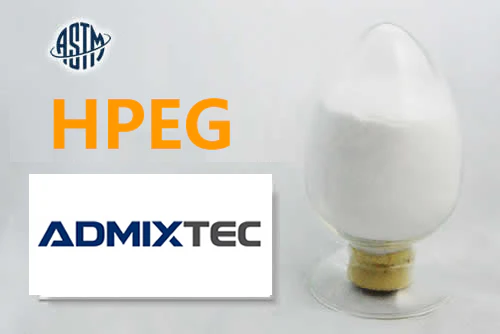
What is HPEG?
HPEG is methallyl polyoxyethylene ether, also called methallyl alcohol polyethylene glycol ether or methyl allyl polyoxyethylene ether. It is a macromonomer: a long polyethylene glycol chain with a reactive methallyl double bond at one end and a hydroxyl group at the other. Admixture producers use HPEG as one of the main raw materials for polycarboxylate ether (PCE) superplasticizers, the high-range water reducers used in modern concrete and mortar.
HPEG does not reduce water by itself when added to concrete. Its value comes from what it becomes after copolymerization. When a PCE manufacturer copolymerizes HPEG with an unsaturated acid such as acrylic acid, the polyethylene glycol chains become the side chains of a comb-shaped polymer. Those side chains largely determine how well the finished PCE disperses cement, how long it maintains slump, and how it behaves with different cements and aggregates.
Commercial HPEG is usually supplied as white to light yellow flakes, granules, or a waxy solid at room temperature. It dissolves readily in water. The most common grade is HPEG-2400, named for its nominal average molecular weight of about 2400 g/mol. Other grades, such as 1200, 2000, and 3000, are also produced for specific formulation goals.
Where HPEG sits among PCE macromonomers
PCE macromonomers are grouped by the unsaturated head group attached to the polyether chain. That head group controls how readily the macromonomer copolymerizes with acrylic acid. HPEG belongs to the second generation of ether-type macromonomers. It replaced APEG (allyl polyoxyethylene ether) in many plants because the methallyl group copolymerizes more efficiently. TPEG and VPEG were developed later to allow polymerization under milder conditions.
| Macromonomer | Unsaturated head group | General copolymerization reactivity | Typical use in PCE production |
|---|---|---|---|
| APEG | Allyl | Low | Older formulations, now less common for high-performance PCE |
| HPEG | Methallyl | Moderate | Widely used for water-reducing and slump-retaining PCE |
| TPEG | Isoprenyl (3-methyl-3-butenyl) | Higher than HPEG | Widely used, including room-temperature processes |
| VPEG | Vinyl ether (e.g. 4-hydroxybutyl vinyl ether based) | High | Low-temperature, fast-reaction processes |
How HPEG works in polycarboxylate superplasticizers?
HPEG works through the structure it gives to the finished PCE polymer. After copolymerization, the PCE molecule has a backbone carrying carboxyl groups from the acid monomer and polyether side chains from HPEG. Each part does a different job once the admixture meets cement in water.
Adsorption through the backbone
Cement particles develop positively charged sites on their surfaces shortly after mixing with water. The negatively charged carboxyl groups on the PCE backbone adsorb onto these sites, anchoring the polymer to the particles. The ratio of acid monomer to HPEG in the recipe sets the charge density of the backbone, which affects how fast and how strongly the polymer adsorbs.
Steric hindrance through the HPEG side chains
Once the backbone is anchored, the HPEG-derived polyethylene glycol side chains extend into the surrounding water. When two coated particles approach each other, these side chains physically keep them apart. This effect, called steric hindrance, is the main dispersion mechanism of PCE superplasticizers. It is more effective than the electrostatic repulsion that older naphthalene-based and melamine-based superplasticizers rely on. Separated cement particles release the water that would otherwise be trapped between flocculated grains. The result is higher fluidity at the same water content, or the same fluidity with less mixing water.
How HPEG molecular weight changes performance
The molecular weight of HPEG sets the length of the side chains. Longer side chains generally give stronger steric hindrance and better initial dispersion per adsorbed molecule. Shorter side chains allow more side chains per backbone and change adsorption behavior. Formulators therefore pair the HPEG grade with the acid ratio, initiator system, and chain transfer agent to target water-reducing, slump-retaining, or low-viscosity PCE. The finished PCE is then tested in the formulator's own cement system, because cement chemistry, sulfate content, and clay in aggregates all influence results.
| Nominal HPEG grade | Approximate side chain length | Common direction in PCE design |
|---|---|---|
| HPEG-1200 | Shorter | Slump-retaining types, special adsorption behavior |
| HPEG-2000 | Medium | Balanced formulations |
| HPEG-2400 | Medium to long | General-purpose water-reducing PCE, the most common grade |
| HPEG-3000 | Longer | High water reduction, early dispersion |
The directions in the table are general tendencies reported across the PCE industry. Final performance depends on the full recipe and process, so they should be treated as a starting point for laboratory work.
How to choose HPEG for PCE production?
Choosing HPEG means matching the macromonomer to your target PCE, your polymerization process, and your quality control capability. The points below are the ones that most often affect batch consistency and final admixture performance.
Match the grade to your target PCE
Start with the type of PCE you need to produce. Plants making general water-reducing PCE for ready-mix concrete commonly use HPEG-2400. Plants developing slump-retaining PCE or products for precast, self-compacting concrete, or high-strength concrete may test several molecular weights. If you are replacing an existing source, ask for the same nominal grade and compare full specifications rather than the grade name alone, because suppliers may target slightly different molecular weight ranges.
Check the key quality indicators
Several parameters on the certificate of analysis (COA) directly predict how HPEG will behave in your reactor. The hydroxyl value is used to confirm the actual average molecular weight. For a monofunctional polyether, the molecular weight can be estimated as 56100 divided by the hydroxyl value in mg KOH/g, so HPEG-2400 corresponds to a hydroxyl value of roughly 23.4 mg KOH/g. The double bond retention rate shows how much of the material still carries a reactive methallyl group. Material with low double bond retention contains more polyethylene glycol that cannot copolymerize, which lowers conversion and weakens the final PCE. Water content, pH of an aqueous solution, and color are also routinely checked.
| Parameter | What it tells you | Why it matters for PCE |
|---|---|---|
| Hydroxyl value (mg KOH/g) | Actual average molecular weight | Controls side chain length and recipe stoichiometry |
| Double bond retention (%) | Share of molecules with a reactive head group | Affects monomer conversion and dispersing efficiency |
| Molecular weight distribution | Uniformity of chain lengths | Narrower distribution supports consistent performance |
| Water content (%) | Moisture in the solid | Affects weighing accuracy and storage stability |
| pH (aqueous solution) | Residual catalyst or acidity | Can influence initiator behavior |
| Color (APHA or Pt-Co) | Degree of oxidation or impurities | Affects the appearance of the finished admixture |
Specific acceptance limits should come from the supplier's documented specification and your own validation. Ask for a COA with every batch and request test methods for each parameter, so your laboratory can reproduce the results.
Consider your polymerization process
HPEG copolymerizes less readily than TPEG or VPEG. Plants using HPEG typically run the reaction at moderate temperatures with persulfate or redox initiator systems, and they control dosing times carefully. If your plant is set up for room-temperature synthesis without heating, TPEG or VPEG may be a better fit. If you already have heated reactors and established HPEG recipes, staying with HPEG avoids reformulation work. Run small-scale trials before switching between macromonomer types, because the acid ratio and initiator dosage usually need adjustment.
Evaluate batch consistency and supply
For B2B purchasing, consistency between batches matters as much as the numbers on a single COA. Ask the supplier for COA data across several recent batches to see how much the hydroxyl value and double bond retention vary. Confirm the packaging format, which is often 25 kg bags for flake material, along with lead times, minimum order quantities, and the shelf life the supplier will support. Request the safety data sheet (SDS) before the first shipment. If your market requires specific certifications or regulatory registrations, ask the supplier for the actual documents and verify them, rather than relying on statements in marketing materials.
Plan for storage and handling
HPEG should be stored in sealed packaging in a cool, dry, ventilated area, away from heat sources and direct sunlight. Flake material can absorb moisture and cake if packaging is left open. Some plants melt HPEG before charging it to the reactor. In that case, avoid prolonged heating at high temperature, because extended thermal exposure can reduce double bond content. Follow the handling guidance in the supplier's SDS.
FAQ
Is HPEG the same as TPEG?
No. Both are polyether macromonomers for PCE superplasticizers, but they have different unsaturated head groups. HPEG uses a methallyl group, and TPEG uses an isoprenyl group. TPEG generally copolymerizes more readily, which allows milder reaction conditions. Recipes developed for one cannot usually be transferred to the other without adjustment.
Can HPEG be added directly to concrete?
No. HPEG is a raw material for making PCE. It has to be copolymerized with an acid monomer such as acrylic acid to form a superplasticizer. Adding unreacted HPEG to concrete does not provide the dispersing effect of a finished PCE.
Which HPEG molecular weight is most common?
HPEG-2400 is the most widely used grade for general-purpose water-reducing PCE. Other grades such as 1200, 2000, and 3000 are chosen when formulators want different side chain lengths for slump retention, viscosity, or water reduction.
Why is double bond retention important?
Only HPEG molecules that still carry the methallyl double bond can join the PCE backbone. Molecules without it remain as unreacted polyethylene glycol in the product. Higher double bond retention therefore supports better monomer conversion and more predictable PCE performance.
What is the shelf life of HPEG?
Shelf life depends on the supplier's specification and storage conditions. Sealed material kept cool and dry stays stable for an extended period, but you should confirm the supported shelf life with the supplier and retest key parameters on older stock before use.
Can I use HPEG together with other macromonomers?
Some formulators blend PCEs made from different macromonomers, or combine macromonomers in one recipe, to balance water reduction and slump retention. This approach requires laboratory development and testing with the cements and aggregates you actually use.
What documents should I request when buying HPEG?
At minimum, request a batch-specific certificate of analysis, the product specification with test methods, and the safety data sheet. If your customers or local regulations require further documentation, ask the supplier for the original documents and verify them before purchase.