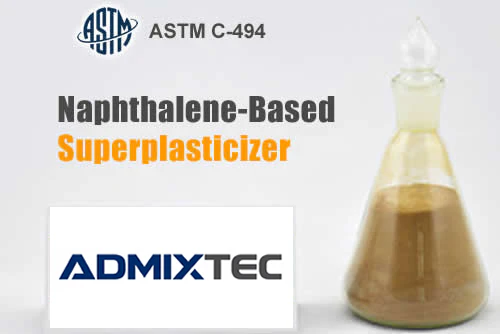
What is SNF Powder?
SNF powder is the solid form of sodium naphthalene formaldehyde sulfonate, a high-range water reducer for concrete and mortar. It is also sold as PNS (polynaphthalene sulfonate), naphthalene-based superplasticizer, or FDN. The product is a free-flowing, light brown to yellowish brown powder that dissolves readily in water. It can be added directly to dry mixes or dissolved on site to make a liquid admixture.
SNF was among the first synthetic superplasticizers used at scale in construction, and many concrete producers still rely on it. Polycarboxylate ether (PCE) superplasticizers achieve higher water reduction at lower dosages. SNF remains in wide use because its cost is predictable, it tolerates variation in cement and aggregates, and decades of field use have made its behavior well understood.
Main Applications
Ready-mix and precast concrete producers use SNF powder to increase slump without adding water, or to reduce water while keeping the same workability. Lower water content produces higher early and final strength, which matters in precast elements, concrete pipes, piles, and steam-cured products. In dry-mix mortars, grouts, and self-leveling compounds, the powder form blends directly with cement and fillers. Outside construction, SNF is also used as a dispersant in gypsum board production and in some dye, pigment, and agricultural formulations.
Typical Technical Parameters
Each manufacturer controls its grades to its own specification, so values differ between suppliers. The table below shows ranges commonly published for commercial SNF powder. It is a general reference, not a guaranteed specification for any single product.
| Parameter | Typical Range | Why It Matters |
|---|---|---|
| Appearance | Light brown to yellowish brown powder | Large changes in color can indicate process or storage differences |
| Solid content | ≥ 92% | Determines active content per kilogram purchased |
| Moisture | ≤ 8% | Affects caking, flowability, and shelf life |
| pH (aqueous solution) | 7 to 9 | Indicates neutralization and compatibility with other admixtures |
| Sodium sulfate (Na2SO4) | < 5% (low), about 10% (medium), about 18 to 20% (high) | Defines the grade and suitability for cold weather and liquid formulation |
| Chloride content | Commonly ≤ 0.3% | Chlorides can contribute to corrosion of steel reinforcement |
| Water reduction in concrete | Roughly 15 to 25% at normal dosage | Main performance indicator for mix design |
How SNF Powder Works in Concrete and Mortar
Cement particles tend to flocculate when they contact water. The clusters they form trap part of the mixing water, and that trapped water does not lubricate the mix. Producers often add extra water to compensate, which raises the water-cement ratio and lowers strength and durability.
Adsorption and Electrostatic Repulsion
SNF is an anionic polymer. When it dissolves, its sulfonate groups carry a negative charge, and the molecules adsorb onto the surfaces of cement grains. The adsorbed layer gives the particles a strong negative surface charge, so neighboring particles repel each other. This electrostatic repulsion breaks up the flocs and releases the trapped water. The paste becomes more fluid at the same water content, or reaches the same fluidity with less water.
PCE superplasticizers disperse cement mainly through steric hindrance created by long side chains. SNF depends mostly on electrostatic repulsion. As cement hydration products build up, the electrostatic effect weakens faster than steric hindrance does, so concrete made with SNF usually loses slump more quickly than PCE concrete. Producers address this with retarders, split dosing, or dosing close to the point of placement.
Effects on Fresh and Hardened Properties
In fresh concrete, SNF increases flowability and improves pumpability, and it can help mixes reach high slump for congested reinforcement. With proper dosage and cohesive mix design, it usually does not cause significant air entrainment or strong set retardation. In hardened concrete, the lower water-cement ratio brings higher compressive strength, lower permeability, and better resistance to aggressive environments. Overdosing can cause bleeding, segregation, or a sticky paste, so the optimal dosage should be established through trial mixes.
Typical Dosage
A common dosage range for SNF powder is about 0.5% to 1.5% of cement weight. The best value depends on the target water reduction, the cement type, the type and amount of supplementary cementitious materials, the fineness of the aggregates, and the ambient temperature. The powder can be added with the mixing water or dissolved in advance, usually to a solution of about 35% to 40% solids, for automatic dosing.
How to Choose SNF Powder for Your Project
For a B2B buyer, choosing SNF powder means matching the product grade to the application and confirming batch-to-batch consistency. The points below are the ones that most affect performance and total cost.
Select the Right Sodium Sulfate Grade
Sodium sulfate is a by-product left in SNF after neutralization, and its content defines the commercial grade. Low-sulfate grades are the better choice for producing concentrated liquid admixtures, because high sulfate content can crystallize out of solution at low temperatures and block tanks and pumps. Low-sulfate grades also suit applications where efflorescence or a high total sulfate load would be a concern. Medium- and high-sulfate grades cost less and work well in many general concrete and precast uses, where the extra sulfate can even contribute slightly to early strength. Buyers should state the required range in the purchase specification and not rely on a generic product name.
| Grade | Approx. Na2SO4 | Typical Use | Considerations |
|---|---|---|---|
| Low sulfate | < 5% | Liquid admixture formulation, cold climates, demanding concrete | Higher price, better solution stability |
| Medium sulfate | About 10% | General ready-mix and precast concrete | Balanced cost and performance |
| High sulfate | About 18 to 20% | Cost-sensitive concrete, some industrial dispersant uses | Risk of crystallization in liquid form at low temperature |
Compare SNF with Other Water Reducers
SNF is not always the best option. Where very low water-cement ratios, self-compacting concrete, or long slump retention are required, PCE is usually more suitable. Where only moderate water reduction is needed at the lowest cost, a lignosulfonate may be enough. The comparison below gives typical performance ranges.
| Property | Lignosulfonate | SNF (Naphthalene-Based) | PCE (Polycarboxylate) |
|---|---|---|---|
| Typical water reduction | About 5 to 12% | About 15 to 25% | About 25 to 40% |
| Main dispersion mechanism | Electrostatic | Electrostatic | Steric hindrance plus electrostatic |
| Slump retention | Moderate, with some retardation | Moderate, loss can be relatively fast | Good, adjustable by molecular design |
| Sensitivity to clay in aggregates | Low to moderate | Relatively low | Often higher |
| Relative cost per unit of performance | Low | Moderate | Higher price per kg, lower dosage |
Verify Quality with Documents and Trial Mixes
Ask each supplier for a technical data sheet, a safety data sheet, and a certificate of analysis for each batch. The certificate of analysis should report solid content, moisture, pH, sodium sulfate, chloride, and fineness. Because SNF is made from formaldehyde, it is reasonable to request residual free formaldehyde data, particularly for indoor products or regulated markets. If a project specification refers to a standard such as ASTM C494 or EN 934-2, ask for test reports from an accredited laboratory that show the product meets it. Marketing statements alone should not be accepted as proof.
Laboratory and plant trials using your own cement, supplementary materials, and aggregates matter most. A cement-paste flow test or mortar flow test can screen compatibility quickly. Concrete trials should then confirm slump, slump loss over time, setting time, and compressive strength at the required ages.
Packaging, Storage, and Supply Reliability
SNF powder is hygroscopic, so it is usually packed in 25 kg bags with a moisture-resistant inner liner, or in jumbo bags for larger plants. It should be stored in a dry, covered place, off the ground and away from rain. Typical shelf life is one to two years in sealed packaging, but buyers should confirm this with the supplier. For long-term supply, evaluate the producer's capacity, its batch-consistency records, its lead times, and the technical support it offers for dosage optimization.
FAQ
What is the difference between SNF, PNS, and FDN?
These names generally describe the same type of product, a sodium salt of naphthalene sulfonate formaldehyde condensate used as a superplasticizer or dispersant. The terms differ by region and supplier convention. Grades can still differ in sulfate content and other parameters, so compare technical data sheets rather than product names.
Can SNF powder be mixed with PCE superplasticizer?
Mixing SNF and PCE directly is generally not recommended. The two can be incompatible, which may cause a sharp loss of workability or poor dispersion. If a plant switches between them, it should clean tanks, pipes, and dispensers thoroughly and confirm results with trial mixes.
Does SNF powder cause corrosion of steel reinforcement?
Commercial SNF typically has low chloride content. Used at normal dosage, it is not regarded as a significant corrosion risk. Buyers making reinforced or prestressed concrete should still check the chloride value on each certificate of analysis against the limits in their project specification.
How do I prepare a liquid admixture from SNF powder?
Producers usually dissolve the powder in clean water with continuous stirring until the solution reaches about 35% to 40% solids. A low-sulfate grade gives the most stable solution, especially in cold weather. Retarders or other components can be added to adjust setting time and slump retention, depending on the formulation.
Why does concrete with SNF lose slump quickly?
SNF disperses cement mainly through electrostatic repulsion, and that effect weakens as hydration products form on particle surfaces. High temperatures, reactive cements, and long transport times make slump loss faster. Common remedies are adding a compatible retarder, dosing in stages, or adding part of the admixture at the job site.
Is SNF powder suitable for gypsum and dry-mix products?
Yes. SNF is widely used as a dispersant in gypsum board production and in cement-based dry-mix mortars, where the powder form blends evenly with other dry components. The dosage and grade should be confirmed through product-specific testing, because gypsum and mortar systems respond differently than concrete.