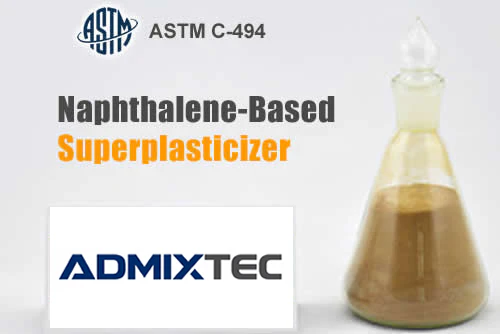
What is Low Sodium Sulfate SNF?
Low sodium sulfate SNF is a grade of sulfonated naphthalene formaldehyde condensate, a high-range water-reducing admixture used in concrete and mortar, in which the residual sodium sulfate (Na2SO4) content is kept at a low level. Commercial SNF products contain some sodium sulfate left over from manufacturing, and suppliers usually sort their products into high, medium, and low sulfate grades according to how much remains. In trade practice, a low sodium sulfate grade generally means a content below about 5% by weight, and many producers offer grades at or below 3%. The exact threshold varies by supplier, so buyers should always check the stated value on the technical data sheet and the batch certificate of analysis.
The active polymer in all SNF grades works the same way. The difference lies in what accompanies it. Sodium sulfate adds no water-reducing effect of its own, so a lower sulfate content means a higher share of active polymer per kilogram of powder. It also changes how the product behaves in solution, in cold storage, and in combination with other admixture components. These properties make low sodium sulfate SNF the usual choice for admixture formulators who produce liquid products, for ready-mix and precast plants operating in cold climates, and for projects where alkali and soluble salt content in concrete must be controlled.
Typical appearance and form
Low sodium sulfate SNF is normally supplied as a light yellow to brown free-flowing powder packed in moisture-resistant bags. Some suppliers also offer it as a liquid solution, commonly around 40% solids. The powder is hygroscopic, so it should be stored in sealed packaging in a dry place. The table below shows general ranges seen in commercial grade descriptions. These figures are indicative, and the values for any specific product must come from that supplier's documentation.
| Grade (common trade naming) | Typical Na2SO4 content | Typical use |
|---|---|---|
| High sodium sulfate SNF | Around 18% to 20% | Powder dosing in general concrete where cost is the main concern |
| Medium sodium sulfate SNF | Around 10% | General concrete and mortar, moderate climates |
| Low sodium sulfate SNF | Below about 5%, often 3% or lower | Liquid admixture formulation, cold-weather use, blending with other admixtures |
How Low Sodium Sulfate SNF Works in Concrete?
SNF is an anionic dispersant. When it is added to fresh concrete or mortar, the sulfonate groups on the polymer chains adsorb onto the surfaces of cement particles. This gives the particles a negative surface charge, and the resulting electrostatic repulsion pushes them apart. Without a dispersant, cement grains tend to flocculate and trap part of the mixing water inside the clusters. Breaking up these flocs releases that water, which increases workability at the same water content or allows the water content to be reduced while keeping the same slump.
At typical dosages, SNF superplasticizers commonly achieve water reductions in the range of about 15% to 25%, depending on the cement, aggregates, mix design, and dosage. Lower water-to-cement ratios lead to higher compressive strength and lower permeability, which is why SNF has been used for decades in high-strength concrete, precast elements, and pumped concrete.
Why the sodium sulfate content matters
Sodium sulfate affects performance in several practical ways. The first is solubility at low temperature. Sodium sulfate becomes much less soluble as temperature drops, and below roughly 15 °C it readily crystallizes out of concentrated solutions as sodium sulfate decahydrate. In liquid admixtures made from high sulfate SNF, this causes sediment in tanks, blocked pumps and dosing lines, and inconsistent dosing. Low sulfate grades greatly reduce this risk, which is the main reason formulators specify them for liquid products sold in cold regions or stored outdoors in winter.
The second is alkali contribution. Sodium sulfate adds sodium ions to the concrete, and these count toward the total alkali content. Where the aggregates may be reactive, specifiers limit total alkalis to manage the risk of alkali-silica reaction. A lower sulfate content reduces the alkali added per unit of dispersant.
The third is surface appearance. Soluble salts can migrate to the surface and contribute to efflorescence, which matters in architectural precast, paving blocks, and decorative mortars. Using a low sulfate grade is one way to reduce the soluble salt load from the admixture.
The fourth is interaction with cement chemistry. Sulfate ions influence early hydration of the aluminate phases in cement, and extra sulfate from the admixture can change setting behavior and early strength development with some cements. A lower and more consistent sulfate level makes the admixture's effect more predictable across different cement sources.
Compared with other water reducers
SNF sits between conventional lignosulfonate water reducers and polycarboxylate ether (PCE) superplasticizers in terms of water reduction. Compared with PCE, SNF is generally less sensitive to clay contamination in aggregates and has a long track record. On the other hand, it usually shows faster slump loss and lower maximum water reduction. Formulators often blend SNF with retarders such as sodium gluconate to extend workability retention.
| Property | Lignosulfonate | SNF (low sodium sulfate) | PCE |
|---|---|---|---|
| Typical water reduction | About 5% to 12% | About 15% to 25% | About 25% to 40% |
| Main dispersion mechanism | Electrostatic repulsion | Electrostatic repulsion | Steric hindrance plus electrostatic repulsion |
| Slump retention | Moderate, with set retardation | Shorter without retarder | Good, adjustable by molecular design |
| Sensitivity to clay in aggregates | Low | Low | Higher |
How to Choose Low Sodium Sulfate SNF?
Choosing the right product starts with how it will be used. A precast plant dosing powder directly into the mixer has different priorities from an admixture company that dissolves SNF into a liquid formulation and ships it to customers in cold regions. The points below explain what to check in each case.
Confirm the sodium sulfate specification
"Low sodium sulfate" has no single industry-wide definition, so ask for the maximum Na2SO4 content as a number on the technical data sheet, together with the test method used. For liquid formulations intended for winter use, a content of 3% or lower in the powder is a common request. Batch certificates of analysis should report the measured value for each lot, so that consistency can be tracked over time.
Review the key quality parameters
Sodium sulfate is only one item on a specification sheet. Solid content shows how much active material and how little moisture the powder contains. Chloride content matters because chlorides can promote corrosion of steel reinforcement, and most concrete specifications limit chloride from all sources. The pH of a solution and the fineness of the powder affect handling and dissolution. Water reduction, which the supplier usually measures on a reference mortar or concrete, gives a first indication of efficiency, but only trials with your own materials will show actual performance.
| Parameter | Why it matters | What to request |
|---|---|---|
| Na2SO4 content | Cold-weather stability, alkali contribution, efflorescence risk | Stated maximum and measured batch value |
| Solid content | Active content and moisture level | Minimum value on the data sheet |
| Chloride content | Corrosion risk for reinforcement | Maximum value and test method |
| pH (of a stated solution) | Compatibility with other formulation components | Range and test concentration |
| Fineness | Dissolution speed and handling | Residue on a stated sieve size |
| Water reduction | Dispersing efficiency | Test conditions and reference mix used |
Run compatibility trials with your own materials
SNF performance depends on the cement's mineral composition, its sulfate balance, the type and amount of supplementary materials such as fly ash or slag, and the aggregates. Before switching suppliers or grades, run mortar or concrete trials that measure initial slump or flow, slump loss over the planned transport time, setting time, air content, and compressive strength at relevant ages. If the SNF will be blended with retarders, defoamers, or other water reducers, test the complete formulation, including storage stability at the lowest temperature it will see.
Check documentation and supply reliability
For B2B purchasing, documentation is as important as the product itself. A reliable supplier should provide a technical data sheet, a safety data sheet, and a certificate of analysis for each batch. If your project requires conformity with a particular admixture standard, such as ASTM C494 or EN 934-2, ask for the relevant test reports and confirm that they cover the specific grade you are buying. Also consider batch-to-batch consistency, lead times, packaging options, and the supplier's capacity to deliver repeat orders at the same specification.
FAQ
What is the difference between low sodium sulfate SNF and standard SNF?
Both contain the same type of active polymer. The low sodium sulfate grade has less residual sodium sulfate, which gives a higher active content per kilogram, better stability in liquid solutions at low temperatures, and a smaller contribution of sodium and soluble salts to the concrete.
Why does high sodium sulfate SNF cause problems in winter?
Sodium sulfate becomes much less soluble as the temperature falls. In liquid admixtures made with high sulfate SNF, it can crystallize in storage tanks and dosing lines during cold weather, which leads to sediment, blockages, and inaccurate dosing. Low sulfate grades reduce this risk.
What is the typical dosage of low sodium sulfate SNF?
Dosages for SNF powder commonly fall between about 0.5% and 1.5% by weight of cementitious material, depending on the target water reduction, the materials, and the mix design. The correct dosage should be determined through trial mixes rather than taken from a general range.
Can low sodium sulfate SNF be blended with other admixtures?
Yes. It is frequently combined with retarders such as sodium gluconate, with lignosulfonates, and with defoamers in liquid formulations. Mixing SNF directly with PCE in the same solution is generally not recommended because the two can interact unfavorably, so any combination should be checked for stability and performance before use.
Is low sodium sulfate SNF suitable for precast and high-strength concrete?
SNF has long been used in precast elements and high-strength concrete because it allows low water-to-cement ratios and supports good early strength development. A low sulfate grade is useful where efflorescence control or alkali limits matter. Suitability for a given project should be confirmed with trials using the actual cement and aggregates.
How should low sodium sulfate SNF powder be stored?
Store the powder in its sealed bags in a dry, covered area away from moisture, because SNF absorbs water from the air and can cake. Reseal opened bags promptly. Follow the shelf life and handling guidance given on the supplier's data sheet and safety data sheet.