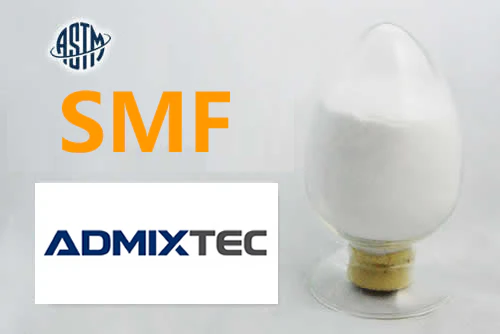
What is SMF Powder?
SMF powder is a high-range water-reducing admixture based on sulfonated melamine formaldehyde condensate, usually supplied as its sodium salt in a free-flowing, spray-dried form. In the construction chemicals industry it is classed with the "second-generation" superplasticizers, together with sulfonated naphthalene formaldehyde (SNF). It disperses cement and other mineral binders so that a mix reaches the required workability with less water, or flows more easily at the same water content.
The powder is typically white to off-white and dissolves readily in water. Because it is a dry product, it is mainly used where a liquid admixture is impractical. Factory-blended dry-mix mortars, self-leveling floor compounds, tile grouts, gypsum-based products, and refractory castables are the most common examples. Ready-mix and precast producers who prefer a liquid can dissolve the powder on site, or buy a liquid SMF grade instead.
Where SMF Powder Is Used
SMF powder has low air entrainment and only a small retarding effect on cement hydration. These traits make it a common choice in applications that need early strength and a dense, smooth surface. Precast concrete plants use it to shorten demolding times. Producers of cementitious and calcium sulfate self-leveling underlayments use it to reach high flow at low water content. Its light color is also an advantage in white or pigmented mortars, where the brown tint of naphthalene-based products can be undesirable.
| Application | Main Reason for Using SMF Powder |
|---|---|
| Self-leveling floor compounds | High flow at low water content, low air entrainment, smooth surface finish |
| Dry-mix mortars and tile grouts | Powder form blends directly into pre-packed products |
| Gypsum and anhydrite products | Effective dispersion of calcium sulfate binders with little effect on setting |
| Precast and early-strength concrete | Minimal retardation supports early strength development |
| White and decorative concrete | Light color does not stain the finished surface |
| Refractory castables | Reduces water demand in dense castable formulations |
Typical Properties of SMF Powder
Exact values differ between manufacturers and grades. The ranges below are typical of those reported in commercial technical data sheets and are given for orientation only. Buyers should always check the certificate of analysis (COA) for each batch.
| Property | Typical Range |
|---|---|
| Appearance | White to off-white free-flowing powder |
| Solid content | About 95% or higher (moisture about 5% or lower) |
| pH (aqueous solution) | Approximately 7 to 10, depending on concentration and grade |
| Bulk density | Approximately 400 to 700 kg/m³ |
| Water reduction in concrete | Commonly 15% to 25% at recommended dosage |
| Typical dosage | About 0.2% to 1.0% by weight of binder |
| Chloride content | Low; confirm on the COA for reinforced concrete use |
How SMF Powder Works in Cement and Gypsum Systems?
Cement particles tend to flocculate when mixed with water. The clusters trap part of the mixing water, which then cannot lubricate the mix. To reach a workable consistency without an admixture, more water has to be added, which raises the water-to-binder ratio and lowers strength and durability.
Adsorption and Electrostatic Repulsion
The SMF molecule carries many negatively charged sulfonate groups. When the powder dissolves in the mixing water, the polymer adsorbs onto the positively charged sites of cement and gypsum particles. Each particle then carries a strong negative surface charge, which shows up as a more negative zeta potential. Neighboring particles repel each other, the flocs break apart, and the trapped water is released into the mix. This electrostatic repulsion is the main dispersing mechanism of SMF. Polycarboxylate ether (PCE) superplasticizers rely mainly on steric hindrance from long side chains, which is a different mechanism.
Effects on Fresh and Hardened Properties
The released water can be used in two ways. A producer can keep the water content constant and gain flow, or keep the flow constant and cut water. Cutting water lowers the water-to-binder ratio, which generally raises compressive strength and reduces permeability. SMF has little influence on setting time and entrains little air. As a result, a mix with SMF tends to keep its early strength gain, and the hardened surface is dense with few pores.
Purely electrostatic dispersion fades as cement hydration products cover the adsorbed polymer. For this reason, SMF mixes usually lose slump faster than comparable PCE mixes. This suits precast work and fast-setting floor compounds, but long transport times in ready-mix concrete may need a retarder or a different admixture type.
| Characteristic | SMF | SNF | PCE |
|---|---|---|---|
| Main dispersing mechanism | Electrostatic repulsion | Electrostatic repulsion | Mainly steric hindrance |
| Typical water reduction | About 15% to 25% | About 15% to 25% | About 25% to 40% |
| Color | White to off-white | Brown | Varies, often light |
| Effect on setting time | Small | Small to moderate | Depends on formulation |
| Air entrainment | Low | Low | May need a defoamer |
| Slump retention | Short | Short to moderate | Can be designed for long retention |
| Sensitivity to clay in aggregates | Relatively low | Relatively low | Relatively high |
How to Choose SMF Powder for Your Application?
The right SMF powder depends on the binder system, the performance target, and the production process. A technical data sheet gives a starting point, but trials with the buyer's own cement, fillers, and aggregates give the reliable answer.
Match the Grade to the Binder and Product
Some SMF grades are optimized for cement-based concrete and mortar. Others are tuned for calcium sulfate binders or for self-leveling compounds where flow and surface finish matter most. A buyer formulating a gypsum self-leveling screed should ask for data from gypsum or anhydrite systems, since performance in Portland cement does not transfer directly. In ternary binders that combine Portland cement, calcium aluminate cement, and calcium sulfate, interactions with accelerators and retarders should be checked in the lab before scale-up.
Evaluate Dispersing Performance by Testing
Comparative testing is the most practical way to judge a supplier's product. For mortars and self-leveling compounds, a flow ring or flow table test at fixed water content shows how much flow a given dose produces. For concrete, slump or slump-flow tests at equal workability show the water reduction. Measuring flow again after 15 and 30 minutes shows how quickly workability is lost. Compressive strength at 1 day and 28 days confirms that the admixture supports the expected strength development. ASTM C494 and EN 934-2 describe recognized test methods for concrete admixtures, and buyers can ask suppliers for test reports against the standard their market requires.
Check Physical Quality of the Powder
For dry-mix producers, physical properties affect blending as much as chemistry does. Low moisture content and good flowability reduce caking in silos and feeders. A consistent particle size helps the powder disperse evenly in the dry blend and dissolve quickly once water is added. Dust behavior and bulk density matter for automated dosing systems. Asking for these values on each COA helps keep production consistent from batch to batch.
Review Documentation and Supply Terms
A reliable supplier provides a technical data sheet, a safety data sheet (SDS), and a batch COA. Because SMF is a formaldehyde condensate, many buyers also request the free formaldehyde content, especially for indoor flooring products subject to emission requirements. Packaging is commonly 25 kg multi-layer bags with a moisture barrier, and some suppliers offer bulk bags for large-volume users. Lead times, sample availability, and technical support for mix trials are also practical factors in supplier selection.
| Selection Factor | What to Check | Why It Matters |
|---|---|---|
| Binder compatibility | Trial results with your cement or gypsum | Dispersing performance varies between binders |
| Water reduction and flow | Flow or slump at fixed dosage | Determines cost-in-use and strength gain |
| Workability retention | Flow loss over 15 to 60 minutes | Affects placing time and need for retarders |
| Moisture and flowability | COA moisture value, caking behavior | Affects storage, silo handling, and dosing |
| Chloride and free formaldehyde | Values on COA or test report | Relevant to reinforcement corrosion and indoor use |
| Documentation | TDS, SDS, COA, test reports | Supports quality control and regulatory review |
FAQ
What is the recommended dosage of SMF powder?
Typical dosages range from about 0.2% to 1.0% by weight of binder. Gypsum and self-leveling systems often work at the lower end, while high-flow concrete may need more. The optimum dose should be set through trials, because overdosing can cause bleeding and segregation.
Can SMF powder be used together with PCE superplasticizers?
SMF and PCE are generally not mixed in the same formulation without testing, because the two can interfere with each other and reduce flow. When switching between them in the same plant, tanks and dosing lines should be cleaned. Any combination should be confirmed by laboratory trials.
Does SMF powder affect setting time?
SMF has only a small retarding effect at normal dosages, which is one reason it is used in precast concrete and fast-setting floor compounds. Setting time still depends on the binder, temperature, and other additives, so it should be measured in the actual mix.
How should SMF powder be stored?
SMF powder absorbs moisture from the air. It should be kept in sealed original packaging in a dry, cool place, away from direct sunlight and rain. Under these conditions the product typically stays usable for at least 12 months, but buyers should follow the shelf life stated on the supplier's data sheet.
What is the difference between SMF powder and SNF powder?
Both disperse cement through electrostatic repulsion and give similar water reduction. SMF is lighter in color and usually retards setting less, which suits white mortars, self-leveling compounds, and early-strength precast work. SNF is brown and is often chosen for general concrete where color is not a concern and cost per unit of water reduction is lower.
Can SMF powder be dissolved to make a liquid admixture?
Yes. The powder dissolves readily in water, and users often prepare a solution of about 20% to 40% solids for dosing into concrete. The solution should be stirred until fully dissolved and protected from freezing.
Is SMF powder safe to handle?
SMF powder can irritate the eyes and respiratory tract as a dust. Workers should wear dust masks, safety glasses, and gloves, and follow the instructions in the supplier's safety data sheet.