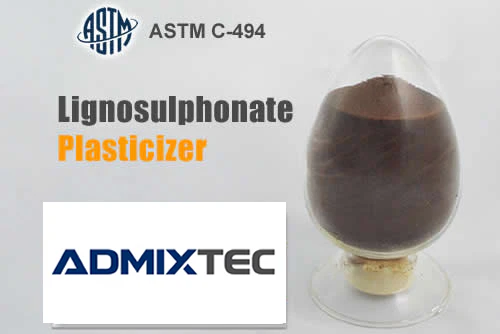
What is Sodium Lignosulfonate?
Sodium lignosulfonate is a water-soluble anionic polymer derived from lignin, the natural binding material in wood. Most commercial supply is recovered from the sulfite pulping process used in paper and cellulose production, where lignin is sulfonated and separated from cellulose fibers. The recovered liquor is purified, adjusted, and usually spray-dried into a yellow-brown to dark brown powder. Liquid grades are also available for plants that dose admixtures through automated systems.
In construction, sodium lignosulfonate is one of the oldest and most widely used water reducers. It belongs to the first generation of concrete admixtures and is commonly classified as a normal-range (also called regular or low-range) water reducer. At typical dosages it lowers the mixing water needed for a given slump by roughly 5% to 12%, depending on the cement, the grade of lignosulfonate, and the mix design. Its modest cost, renewable raw material origin, and good tolerance across many cement types keep it in steady use alongside newer high-range products.
Where Sodium Lignosulfonate Is Used in Concrete and Mortar
Ready-mix producers use sodium lignosulfonate to improve workability, reduce water-cement ratio, or cut cement content while holding strength. Because it tends to delay setting, it is useful in hot weather concreting, long-haul deliveries, and mass concrete pours where controlled heat release and extended working time help avoid cold joints. Mortar and grout producers use it to improve spreadability and reduce bleeding.
A large share of sodium lignosulfonate is also used as a blending component. Formulators combine it with sodium naphthalene sulfonate formaldehyde (SNF) or polycarboxylate ether (PCE) superplasticizers to adjust slump retention, set time, and cost. In these blends, lignosulfonate contributes retardation and economy, while the high-range component delivers most of the water reduction.
Position Among Water-Reducing Admixtures
The table below compares sodium lignosulfonate with the two main high-range water reducers. The ranges are typical industry values for orientation; actual performance depends on cement chemistry, aggregates, temperature, and dosage, and should be confirmed by trial mixes.
| Property | Sodium Lignosulfonate | Sodium Naphthalene Sulfonate (SNF) | Polycarboxylate Ether (PCE) |
|---|---|---|---|
| Category | Normal-range water reducer | High-range water reducer | High-range water reducer |
| Typical water reduction | About 5% to 12% | About 15% to 25% | About 25% to 40% |
| Typical dosage (solids, by weight of cement) | About 0.15% to 0.3% | About 0.5% to 1.0% | About 0.1% to 0.3% |
| Effect on setting time | Retards, more so at higher dosage | Slight effect | Varies by molecular design |
| Air entrainment | Moderate; may need defoamer in some mixes | Low | Can be significant; usually formulated with defoamer |
| Raw material origin | Wood lignin (renewable) | Petrochemical | Petrochemical |
| Relative cost | Low | Medium | Higher per kg, often efficient per m³ |
How Sodium Lignosulfonate Works in Concrete?
When cement is mixed with water, its fine particles carry surface charges that make them attract each other and form flocs. These flocs trap part of the mixing water, so that water does nothing for workability. Sodium lignosulfonate breaks up this flocculation and releases the trapped water, which allows the same slump to be reached with less water.
Adsorption and Electrostatic Repulsion
Lignosulfonate molecules carry sulfonate groups that become negatively charged in water. The molecules adsorb onto the surfaces of cement grains and early hydration products, giving each particle a similar negative charge. Particles with like charges repel each other, so the cement disperses more evenly through the paste. The branched, bulky shape of the lignin backbone adds a limited steric effect, but electrostatic repulsion is the main mechanism. This is why lignosulfonate is less powerful than PCE, which relies on long side chains for strong steric hindrance.
Effect on Setting and Hydration
Sodium lignosulfonate slows the early hydration of cement. The adsorbed layer reduces access of water to reactive clinker phases, and residual wood sugars (reported as reducing substances) present in many grades add further retardation. At normal dosage this delay is moderate and often welcome. At excessive dosage, setting can be delayed for many hours and early strength gain can suffer. Desugared or low-sugar grades are produced for users who want the dispersing effect with less retardation.
Effect on Air Content
Lignosulfonates have some surface activity and can entrain a small amount of air in concrete. This can slightly improve cohesion and workability, but uncontrolled air reduces compressive strength. Producers who need tight air control often add a defoamer to the admixture formulation or adjust the dosage of any separate air-entraining agent.
Practical Benefits for Mix Design
A concrete producer can use the dispersing effect of sodium lignosulfonate in three ways. Keeping water and cement constant increases slump and makes placing and pumping easier. Keeping slump constant and reducing water lowers the water-cement ratio, which raises strength and reduces permeability. Keeping strength constant allows a modest reduction in cement content, which lowers material cost and heat of hydration.
How to Choose Sodium Lignosulfonate for Your Application?
Sodium lignosulfonate is a natural by-product, so its composition varies with wood species, pulping conditions, and purification. Two products sold under the same name can perform quite differently in the same concrete. Buyers should compare grades on measured properties and confirm performance with their own cement and aggregates.
Key Technical Parameters
The parameters below are the ones most often found on a supplier's technical data sheet and certificate of analysis. The ranges shown are common for construction grades and are given for reference only. Buyers should request batch-specific test reports rather than rely on generic values.
| Parameter | Common Range for Construction Grades | Why It Matters |
|---|---|---|
| Appearance | Yellow-brown to dark brown free-flowing powder | Clumping may indicate moisture uptake during storage |
| Lignosulfonate content | Often 50% to 65% or higher | Higher active content gives more dispersing effect per kg |
| Reducing substances (sugars) | Varies widely; low-sugar grades are often below about 5% | Higher sugar content increases set retardation |
| Moisture | Usually below about 7% to 8% | Affects active content and storage stability |
| pH (aqueous solution) | Often about 4 to 9, depending on grade | Influences compatibility in liquid blends with SNF or PCE |
| Water-insoluble matter | Usually below about 1.5% | Insolubles can settle in tanks and block dosing equipment |
| Chloride and sulfate content | Should be stated on the test report | Chloride affects reinforcement corrosion risk; sulfate affects compatibility |
Matching the Grade to the Job
For hot weather concreting, long transport times, or mass pours, a standard grade with moderate sugar content can provide useful retardation without a separate retarder. For precast work or cold weather placement, where early strength matters, a desugared grade or a lower dosage is the safer choice. For admixture formulators who blend with SNF, sodium lignosulfonate is often preferred over calcium lignosulfonate because sodium salts tend to give clearer, more stable liquid blends. For blends with PCE, compatibility should be tested in the lab, since some lignosulfonate grades can reduce PCE efficiency or cause separation in the tank.
Testing and Trial Mixes
Cement composition, especially the content of tricalcium aluminate and soluble alkali sulfates, strongly affects how any water reducer performs. Before switching suppliers or grades, run trial mixes that measure slump at several intervals, initial and final setting time, air content, and compressive strength at 1, 3, 7, and 28 days. Many buyers evaluate admixtures against the test methods in ASTM C494 or EN 934-2. These standards define performance requirements for water-reducing admixtures, but conformance must be shown through test reports for a specific product. A product name alone does not establish it.
Supplier Evaluation for B2B Buyers
Batch consistency matters as much as the headline specification. A reliable supplier should provide a technical data sheet, a safety data sheet, and a certificate of analysis for each shipment, and should be able to explain how incoming raw liquor is controlled. Ask for retained samples from previous batches if you plan long-term purchasing. Confirm packaging format, typically 25 kg multi-wall bags or larger bulk bags for powder and drums or IBC tanks for liquid. Also confirm lead time, minimum order quantity, and whether the supplier can hold a defined specification range across orders.
Storage and Handling
Sodium lignosulfonate powder is hygroscopic and will cake if exposed to humid air. Store it in sealed packaging in a dry, ventilated area away from direct sunlight. Liquid solutions should be kept from freezing and stirred or recirculated if stored for long periods. Dust from the powder can irritate eyes and the respiratory tract, so handling should follow the supplier's safety data sheet, including dust control and suitable personal protective equipment.
FAQ
What is the typical dosage of sodium lignosulfonate in concrete?
Typical dosage is about 0.15% to 0.3% of solids by weight of cement. The right dosage depends on the cement, the grade, the target slump, and the acceptable set time, and should be fixed through trial mixes. Exceeding the optimum dosage gives little extra water reduction and can cause severe set delay and excess air.
Is sodium lignosulfonate a superplasticizer?
It is usually classified as a normal-range water reducer rather than a high-range superplasticizer, because its water reduction is lower than that of SNF or PCE. It is often used together with these superplasticizers in blended admixtures.
What is the difference between sodium lignosulfonate and calcium lignosulfonate?
Both come from the same lignin source and work in a similar way in concrete. The difference is the counter-ion. Sodium lignosulfonate generally has higher solubility and tends to blend more smoothly with SNF in liquid formulations. Calcium lignosulfonate is often slightly cheaper and is widely used as a standalone powder admixture.
Why does sodium lignosulfonate delay concrete setting?
Adsorbed lignosulfonate slows the early reaction of cement with water, and residual sugars in many grades add further retardation. Low-sugar or desugared grades reduce this effect when faster setting is needed.
Can sodium lignosulfonate be used with polycarboxylate superplasticizers?
Yes, but compatibility varies by grade and must be checked. Some combinations work well and improve slump retention at lower cost. Others can reduce PCE dispersing efficiency or separate in storage. Lab testing of both the blended liquid and the resulting concrete is recommended.
Does sodium lignosulfonate contain chloride?
Construction grades are normally low in chloride, but the content depends on the source and processing. Chloride content should be stated on the supplier's test report, especially for reinforced and prestressed concrete.
What is the shelf life of sodium lignosulfonate powder?
When kept sealed in dry conditions, the powder generally stays usable for a long period, and many suppliers state 12 to 24 months. Check the supplier's data sheet for the stated shelf life, and inspect for caking before use.
Is sodium lignosulfonate used outside construction?
Yes. It is also used as a dispersant and binder in dyes, pesticide formulations, ceramics, animal feed pellets, briquetting, and drilling fluids. Grades for these uses may have different specifications from concrete grades, so buyers should specify the intended application when ordering.