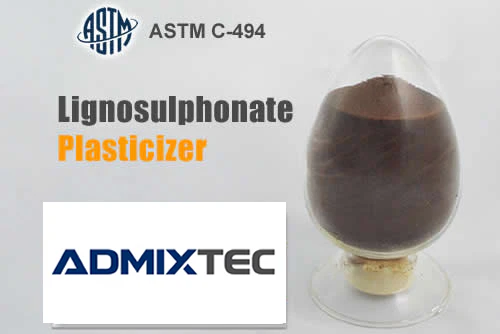
What is Calcium Lignosulfonate?
Calcium lignosulfonate is a water-soluble anionic polymer obtained from lignin, the natural binding component of wood. It is recovered from the spent liquor of the sulfite pulping process, in which wood chips are cooked with calcium bisulfite to separate cellulose fibers from lignin. After the liquor is concentrated, purified, and spray-dried, the product is usually supplied as a free-flowing yellow-brown to dark-brown powder. Liquid solutions are also available for plants that dose admixtures by volume.
In concrete and mortar, calcium lignosulfonate is classed as a normal-range water reducer, also called a plasticizer. It is one of the oldest and most widely used concrete admixtures, and it remains popular because it is cost-effective, easy to handle, and readily available in large volumes. At typical dosages, it lowers mixing water by roughly 5% to 12% at the same slump, or increases slump at the same water content. This places it below naphthalene-based and polycarboxylate-based superplasticizers in dispersing power, but well suited to general-purpose concrete where moderate water reduction is enough.
Calcium lignosulfonate also has a mild set-retarding and air-entraining effect. These secondary effects are useful in hot weather, long-haul ready-mix delivery, and mass concrete, where extended workability and lower early heat are desirable. Outside construction, the same material is used as a binder and dispersant in animal feed pellets, ceramic bodies, refractory products, briquettes, dust control, and agricultural formulations, so buyers will often see several grades offered by the same producer.
| Admixture type | Typical water reduction | Typical dosage (by weight of cement) | Main use |
|---|---|---|---|
| Calcium lignosulfonate | About 5% to 12% | About 0.2% to 0.3% (solid basis) | General ready-mix, mortar, mass concrete, blended admixtures |
| Naphthalene sulfonate formaldehyde (SNF) | About 15% to 25% | About 0.5% to 1.0% | Precast, high-strength concrete |
| Polycarboxylate ether (PCE) | About 25% to 40% | About 0.1% to 0.3% (solid basis) | Self-compacting, high-performance concrete |
The ranges above are typical values reported in industry practice. Actual performance depends on the cement, supplementary materials, aggregates, and temperature, so trial mixes are always needed.
How Calcium Lignosulfonate Works?
Dispersion of cement particles
When cement is mixed with water, its fine particles tend to clump into flocs that trap part of the mixing water. That trapped water does not help the mix flow. Calcium lignosulfonate molecules carry negatively charged sulfonate groups, and they adsorb onto the positively charged sites of cement grains and early hydration products. The adsorbed layer gives neighboring particles a similar negative surface charge, so they repel each other. The flocs break apart, the trapped water is released, and the mix becomes more fluid without extra water. The bulky, branched lignin structure also adds a small steric barrier, although electrostatic repulsion is the main mechanism.
Effect on setting time
Lignosulfonates contain residual wood sugars and other low-molecular-weight compounds. Together with the adsorbed polymer itself, these substances slow the early hydration of tricalcium silicate and tricalcium aluminate. The result is a longer initial and final setting time. At normal dosages, the delay is moderate and often helpful. At high dosages, especially with grades high in reducing sugars, retardation can become excessive and delay strength gain by a day or more.
Effect on air content
Calcium lignosulfonate has some surface activity, so it tends to entrain a small amount of air. This can improve cohesion and pumpability. Excess air, however, lowers compressive strength, so mixes with higher dosages may need a defoaming agent. Some formulators add tributyl phosphate or similar defoamers to control this effect.
Resulting benefits in concrete and mortar
By lowering the water-to-cement ratio at the same workability, calcium lignosulfonate helps increase compressive strength, reduce permeability, and limit bleeding and segregation. Alternatively, a producer can keep the same strength and reduce cement content, which lowers material cost and heat of hydration. Improved cohesion also makes concrete easier to pump and place. On its own, calcium lignosulfonate does not provide the high flow needed for self-compacting concrete, but it is frequently blended with naphthalene or polycarboxylate superplasticizers to adjust slump retention and cost.
How to Choose Calcium Lignosulfonate?
Check the key quality indicators
Calcium lignosulfonate is a natural product, and its composition varies with the wood species, pulping conditions, and purification steps. Buyers should therefore compare grades by their certificate of analysis rather than by product name. The table below shows commonly quoted parameters and the reason each one matters. The values are indicative ranges seen in commercial concrete grades. Always confirm the exact limits with the supplier's technical data sheet and batch certificate.
| Parameter | Indicative range for concrete grades | Why it matters |
|---|---|---|
| Appearance | Yellow-brown to brown powder | Unusual color or caking can indicate contamination or moisture uptake |
| Lignosulfonate content | About 50% to 65% | Higher active content generally gives more consistent water reduction |
| Reducing sugar content | Often below 5% to 12%, depending on grade | Higher sugar increases retardation; low-sugar grades suit tighter set control |
| Moisture | Usually below 7% to 9% | Affects storage stability and true active dosage |
| pH (aqueous solution) | About 4 to 6 | Indicates processing consistency and compatibility with blends |
| Water-insoluble matter | Usually below 1.5% to 2% | Insolubles can settle in liquid admixtures and block dosing equipment |
Match the grade to the application
For general ready-mix concrete, a standard grade with moderate reducing sugar content usually offers the best balance of cost and workability retention. For hot-weather work or long delivery times, the natural retardation of a standard grade can be an advantage. For precast production, cold weather, or steam-cured elements, where early strength matters, a desugared or low-sugar grade is usually preferable because it reduces the risk of delayed setting. If the lignosulfonate will be blended with naphthalene or polycarboxylate superplasticizers, the producer should test compatibility in the liquid blend as well as in concrete, since some combinations can cause precipitation, viscosity changes, or loss of performance.
Run trial mixes with your own materials
Cement chemistry has a strong effect on lignosulfonate performance. Cements with different C3A, alkali, and sulfate contents can respond very differently to the same dosage, and fly ash or slag changes the picture again. Before switching suppliers or grades, a concrete producer should run trial batches that measure slump and slump loss over time, air content, initial and final setting time, and compressive strength at 3, 7, and 28 days. Recognized test frameworks such as ASTM C494 and EN 934-2 describe how water-reducing admixtures are evaluated, and buyers can ask suppliers whether test reports against these methods are available for a given grade. A supplier should provide such reports as documents, not as verbal claims.
Evaluate supplier consistency and support
Because the raw material is a by-product of pulping, batch-to-batch consistency is one of the most important purchasing criteria. A reliable supplier issues a certificate of analysis for every batch, keeps retained samples, and can explain its control limits for lignosulfonate content, reducing sugar, and moisture. Buyers should also confirm packaging, typically multi-wall paper or woven bags with a moisture barrier, as well as palletizing, lead time, and recommended shelf life. Technical support for dosage optimization and blend formulation is a practical advantage, especially for producers new to lignosulfonate-based admixtures.
Consider storage and handling
Calcium lignosulfonate powder is hygroscopic and will cake if exposed to humid air. It should be stored in sealed packaging in a dry, ventilated area away from direct moisture. Liquid solutions should be protected from freezing and checked for sediment before use. The product is generally regarded as low hazard, but dust should be controlled during handling, and users should follow the safety data sheet supplied with each product.
FAQ
What is the typical dosage of calcium lignosulfonate in concrete?
The common range is about 0.2% to 0.3% of cement weight on a solid basis, with 0.25% often used as a starting point. The optimum dosage should be confirmed by trial mixes, because overdosing can cause excessive retardation and high air content.
What is the difference between calcium lignosulfonate and sodium lignosulfonate?
Both are lignosulfonates with similar dispersing behavior in concrete. Calcium lignosulfonate comes from calcium-based sulfite pulping and is generally the lower-cost option for standard concrete use. Sodium lignosulfonate is more soluble and is often preferred when the material will be blended into concentrated liquid admixtures, since calcium ions can react with some other components. The right choice depends on the formulation and the supplier's test data.
Can calcium lignosulfonate replace a polycarboxylate superplasticizer?
Not in applications that need high-range water reduction, such as self-compacting or high-strength concrete. Calcium lignosulfonate provides roughly 5% to 12% water reduction, while polycarboxylate superplasticizers can exceed 25%. It is, however, often used together with polycarboxylate or naphthalene products to reduce cost or improve slump retention, provided compatibility has been tested.
Why does my concrete set slowly after adding calcium lignosulfonate?
Slow setting is usually caused by overdosing, by a grade with high reducing sugar content, or by low ambient temperature. Reducing the dosage, switching to a low-sugar grade, or adjusting the mix for cold weather usually solves the problem. Retardation should always be checked in trial batches before full production.
Does calcium lignosulfonate contain chloride?
Lignosulfonate water reducers are generally low in chloride, but the actual chloride content depends on the raw material and processing. For reinforced and prestressed concrete, buyers should request the measured chloride content on the certificate of analysis and check it against the limits of the applicable project specification.
Can calcium lignosulfonate be used in mortar and dry-mix products?
Yes. The powder form mixes easily into dry mortar, grouts, and plasters, where it improves workability and reduces water demand. Dosage and possible air entrainment should be tested in the actual formulation, because other additives such as cellulose ethers and redispersible powders can change the result.
How should calcium lignosulfonate be stored, and how long does it last?
It should be kept in sealed bags in a cool, dry place, because the powder absorbs moisture and can cake. When stored properly, it remains usable for a long period, but the exact recommended shelf life varies by producer. Buyers should follow the shelf life stated on the supplier's technical data sheet and retest older stock before use.