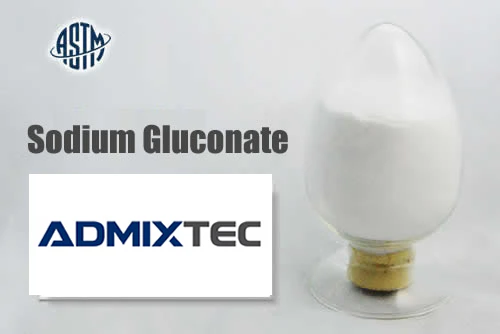
What is Sodium Gluconate?
Sodium gluconate is the sodium salt of gluconic acid, an organic acid derived from glucose. Its molecular formula is C6H11NaO7, its CAS number is 527-07-1, and its molar mass is about 218.14 g/mol. It is usually supplied as a white to off-white crystalline powder or granule. It dissolves readily in water, is only slightly soluble in alcohol, and is insoluble in non-polar solvents. It is non-corrosive and has low toxicity, and it remains stable in alkaline environments. That stability matters in concrete, where pore solution pH is typically above 12.
In construction chemicals, sodium gluconate is best known as a set retarder for concrete and mortar. It also gives a moderate water-reducing (plasticizing) effect, which is why it is often classified as a retarding water reducer when used alone at suitable dosages. Its most common modern role is as a blending component in polycarboxylate ether (PCE) superplasticizer formulations. In these blends it extends setting time and helps control slump loss during transport, pumping, and placement, especially in hot weather or on long haul distances.
Outside concrete, the same chelating ability makes sodium gluconate useful in industrial cleaning, metal surface treatment, textile processing, and water treatment, where it binds calcium, iron, and other metal ions. Food-grade and pharmaceutical-grade materials also exist, but construction applications normally use industrial (technical) grade material.
Key Physical and Chemical Properties
| Property | Description |
|---|---|
| Chemical name | Sodium D-gluconate |
| CAS number | 527-07-1 |
| Molecular formula | C6H11NaO7 |
| Molar mass | Approx. 218.14 g/mol |
| Appearance | White to off-white crystalline powder or granules |
| Solubility | Highly soluble in water; slightly soluble in alcohol |
| Chemical behavior | Strong chelating agent for Ca²⁺ and other metal ions, especially in alkaline solutions |
Role Within the Admixture Family
Sodium gluconate is not a high-range water reducer on its own. Its water reduction is moderate, so it rarely replaces a superplasticizer. Instead, it complements PCE or naphthalene-based products. The superplasticizer supplies most of the dispersion and water reduction, and sodium gluconate adjusts setting behavior and workability retention. Because it is low in cost, easy to dissolve, and compatible with most liquid admixture systems, it is one of the most widely used retarding components in ready-mix concrete formulations.
How Sodium Gluconate Works in Concrete and Mortar?
Sodium gluconate influences cement hydration in two ways: it interacts chemically with calcium in the pore solution, and it adsorbs physically onto cement particles. Together these effects delay the early growth of hydration products. Fresh concrete therefore stays plastic for longer, and later strength development is not compromised at correct dosages.
Chelation and Adsorption
The gluconate anion carries several hydroxyl groups and one carboxylate group. In the high-pH environment of fresh cement paste, these groups form complexes with calcium ions. Gluconate molecules also adsorb onto the surfaces of cement grains and early hydration products. This adsorbed layer, combined with the reduced availability of calcium ions, slows the nucleation and growth of calcium silicate hydrate (C-S-H) and calcium hydroxide. Delaying these hydration products extends the dormant period, so initial and final setting are postponed.
Dispersion and Water-Reducing Effect
Adsorbed gluconate also increases the negative surface charge of cement particles, which adds electrostatic repulsion between them. This releases some water that would otherwise be trapped in particle agglomerates, giving a modest improvement in fluidity. The effect is far smaller than the steric hindrance provided by PCE side chains. It still helps the blended admixture maintain slump over time, because the retarded paste consumes free water and stiffens more slowly.
Dosage Sensitivity and Hydration Behavior
Retardation from sodium gluconate increases with dosage, and the relationship is not linear. In typical concrete practice, dosages fall roughly between 0.01% and 0.1% by weight of cementitious material. The exact value depends on cement chemistry, temperature, and the target setting time. Above a certain level, retardation can become excessive and setting may be delayed by many hours or longer, which hurts early strength and formwork turnover. Sodium gluconate also interacts with the aluminate phases and the sulfate balance of cement. As a result, the same dosage can produce noticeably different setting times with different cements. This variability is the main reason dosages should be set through trial mixes, not copied from another project.
| Factor | Effect on Sodium Gluconate Performance |
|---|---|
| Dosage | Higher dosage gives longer retardation; overdosing can cause severe setting delay and reduced early strength |
| Temperature | Higher concrete temperatures accelerate hydration, so more retarder is generally needed to achieve the same setting time |
| Cement composition | C3A content, alkali content, and sulfate form and amount all influence the degree of retardation |
| Supplementary materials | Fly ash, slag, and other SCMs change hydration kinetics and can intensify or reduce the retarding effect |
| Addition timing | Adding the admixture with or after the mixing water, rather than to dry cement, usually gives more predictable results |
Typical Applications
Ready-mix producers use sodium gluconate in PCE blends to keep concrete workable during long delivery times and summer pours. In mass concrete, delayed hydration spreads heat release over a longer period, which can help manage peak temperatures when combined with proper mix design and thermal control. In large continuous pours, retarded concrete lets successive layers bond without cold joints. In dry-mix mortars, tile adhesives, and gypsum-free cement-based products, small amounts extend open time and working time. Precast plants use it less often, because their production schedules usually favor fast strength gain.
How to Choose Sodium Gluconate for Construction Use?
Selecting sodium gluconate involves more than comparing price per tonne. The buyer has to judge purity, impurity limits, physical form, batch consistency, and compatibility with the existing admixture system. The final check is a trial mix with the actual cement and aggregates that will be used on the project.
Grade and Purity
Industrial-grade sodium gluconate is the normal choice for concrete admixtures. Suppliers usually specify the main assay as a minimum percentage, commonly 98% or higher for construction use. Lower-purity material may contain more residual sugars or reducing substances, which can change retardation strength and cause batch-to-batch variation. Food or pharmaceutical grades are technically suitable but cost more without offering a benefit in concrete. Buyers should request a certificate of analysis (COA) for each batch and compare the reported values against the agreed specification.
Parameters to Review on a Specification Sheet
| Parameter | Why It Matters |
|---|---|
| Assay (purity) | Determines the effective active content and the consistency of retarding performance |
| Loss on drying (moisture) | High moisture reduces active content per kilogram and may cause caking during storage |
| Chloride content | Chlorides can contribute to corrosion of steel reinforcement; low limits are preferred for reinforced and prestressed concrete |
| Sulfate content | Affects the sulfate balance of the admixture and can influence compatibility with cement |
| Reducing substances | Indicates residual sugars that may make setting time less predictable |
| Heavy metals and lead | Relevant for environmental and occupational safety requirements |
| Particle form and flowability | Affects dissolution speed in liquid admixture production and handling in dry-mix plants |
Compatibility With Superplasticizers
Most PCE formulations accept sodium gluconate well, but compatibility should still be tested. Blend stability, appearance, and storage behavior of the final liquid admixture need to be confirmed. Some formulators combine sodium gluconate with other retarding components, such as sugars, hydroxycarboxylic acid salts, or phosphates, to fine-tune setting curves. In those cases the ratio between components changes performance. A blend that works well in one cement market may need adjustment in another.
Trial Mixes and Performance Verification
Before purchase or formulation changes, run laboratory trial mixes with the project cement, supplementary materials, and aggregates. Measure initial and final setting time, slump or slump flow retention over the expected haul time, air content, and compressive strength at early and later ages. Test at the temperatures expected on site, because a dosage that suits 20 °C may be too weak at 35 °C or too strong in cool weather. Recognized test frameworks, such as ASTM C494 for chemical admixtures and EN 934-2 for concrete admixtures, describe how retarding and water-reducing performance is evaluated. Whether a finished admixture meets a given type or class depends on testing of that specific product, and test reports should be requested from the supplier when standard classification is required.
Supply, Packaging, and Storage
Sodium gluconate is commonly supplied in 25 kg multi-layer bags with inner liners, or in larger bulk bags for high-volume users. Because the powder can absorb moisture, it should be stored in a dry, covered area with packaging kept sealed between uses. For B2B buyers, consistent quality across shipments matters as much as the specification itself. Ask suppliers about batch traceability, retained samples, COA practice, and lead times. Also confirm that a safety data sheet (SDS) is available in the required language and format for your market.
FAQ
Is sodium gluconate a superplasticizer?
No. Sodium gluconate is mainly a set retarder with a moderate water-reducing effect. It is frequently blended with superplasticizers such as PCE to extend setting time and improve slump retention, while the superplasticizer provides most of the water reduction.
What is the typical dosage of sodium gluconate in concrete?
Dosages commonly fall around 0.01% to 0.1% by weight of cementitious material. The correct dosage depends on cement type, supplementary materials, ambient and concrete temperature, and required setting time, so it should be confirmed through trial mixes.
What happens if too much sodium gluconate is added?
Overdosing can delay setting far beyond the intended time, sometimes by a day or more, and reduce early-age strength. In severe cases concrete may remain soft long enough to disrupt formwork removal and construction schedules. Accurate batching and verified dosages prevent this problem.
Does sodium gluconate reduce the final strength of concrete?
At correct dosages, sodium gluconate mainly affects early hydration. Later-age strength is usually comparable to, or in some mixes slightly higher than, the reference mix, partly because of the modest water reduction. Early strength will be lower during the retarded period, and that should be considered in project planning.
Can sodium gluconate be used in reinforced concrete?
Sodium gluconate itself is not considered corrosive to steel reinforcement. Buyers should still check the chloride content of the supplied material, since chlorides from impurities can matter in reinforced and prestressed concrete.
Is sodium gluconate suitable for hot-weather concreting?
Yes. Hot weather is one of its most common uses. High temperatures accelerate cement hydration and slump loss, and sodium gluconate helps offset this by delaying setting. Dosage often needs to be adjusted seasonally to keep setting times consistent.
How should sodium gluconate be stored?
Store it in sealed packaging in a dry, covered location, away from moisture and direct contact with the ground. Under proper storage conditions it remains chemically stable, although caking can occur if it absorbs humidity.
Can sodium gluconate be used in mortar and dry-mix products?
Yes. In cement-based mortars, renders, and tile adhesives, small amounts of sodium gluconate extend working time and open time. Its fine powder form and good water solubility make it convenient for dry-mix production, though dosage should be tested with the specific binder system.